
Download PDF
200145
Press release
Representative survey: German population not convinced that the country’s water supply is crisis-proof
February 9, 2026
- Ischinger: Resilience of critical, sustainable infrastructure must be at the heart of national security strategy
- Ahead of the Munich Security Conference: IFAT Munich survey reveals concerns about targeted attacks on infrastructure
- High perception of risk for physical sabotage and cyber attacks
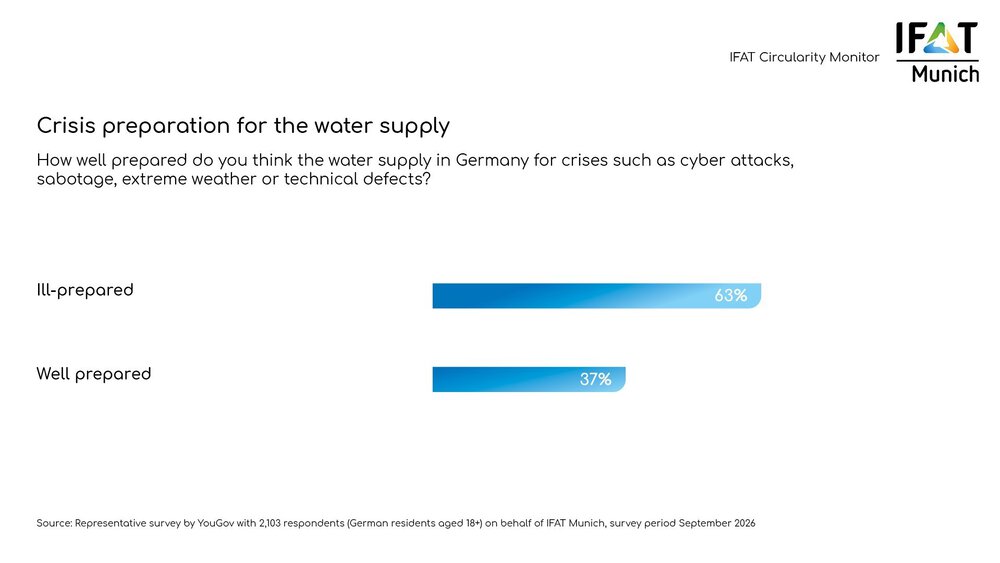
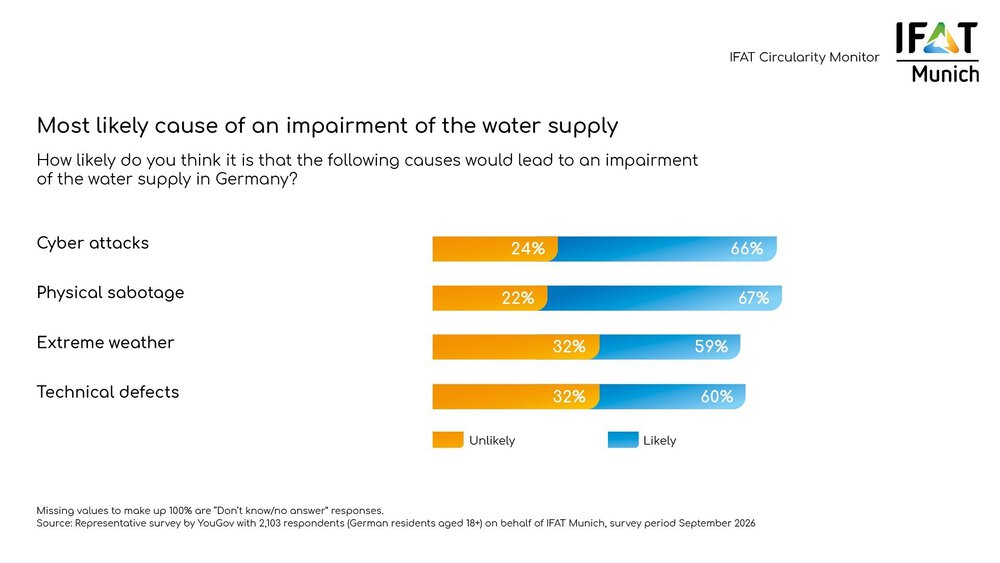
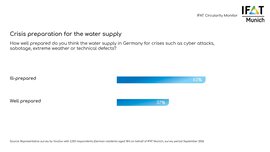
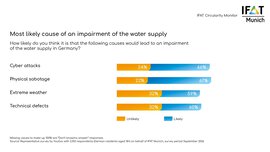
The German population believes that the security of the water supply is becoming a key risk and location issue for their country. The IFAT Circularity Monitor, a representative YouGov survey* conducted by IFAT Munich in the run-up to the Munich Security Conference, shows that 63 percent of respondents consider Germany to be poorly prepared or not prepared at all for crises in the water supply. Only three percent rate the preparation as very good. There is a particularly high level of concern about targeted attacks on infrastructure through physical sabotage (67 percent)** or cyber attacks (66 percent)**. In other words, the current security policy challenges are not just about borders. They start with the stability of critical infrastructures that shape everyday life.
Ischinger: ‘Resilience of critical infrastructure as part of green defence’
‘The high level of risk awareness among the population shows that the protection of the water supply needs to be rethought in terms of security policy,’ says Wolfgang Ischinger, Chairman of the Munich Security Conference. ‘Especially in terms of green defence, the resilience of critical, sustainable infrastructure – including its protection against sabotage and cyber attacks – must be at the heart of national security strategy.’ While the Munich Security Conference discusses the strategic dimensions of such threats, IFAT Munich focuses on practical implementation.
IFAT Munich as a platform for resilient solutions
The world's leading trade fair for environmental technologies, which will take place in Munich from 4 to 7 May 2026, sees itself as a platform where security policy issues are also translated into concrete solutions. ‘Under the guiding principle of green defence addressed by Wolfgang Ischinger, technologies, concepts and best practices will be presented that can be used to make water and wastewater systems more resilient, secure and sustainable,’ says Exhibition Director Philipp Eisenmann.
High risk awareness for sabotage and cyber attacks
Basically, trust in the security of the drinking water supply in Germany is high, as was recently confirmed again in the Water Industry 2025 survey. However, future threats are causing increasing concern. The focus is shifting to an area that was long considered technically manageable, but is now being perceived more and more as part of the national security architecture. “The survey makes it clear that water infrastructure is no longer regarded solely as a technical task, but as a safety-related factor,” says Wolf Merkel, Chairman of the DVGW German Technical and Scientific Association for Gas and Water. “Today, supply security cannot be thought of as an isolated issue. It requires integrated concepts that combine physical protection, cyber resilience and climate adaptation.”
It is striking that although extreme weather events are perceived as a relevant risk by the respondents, they come after targeted attacks – with 59% of respondents seeing them as a probable threat to the water supply. This points to a changed understanding of security in a time of hybrid threats and growing geopolitical tension.
Wastewater as an underestimated key resource
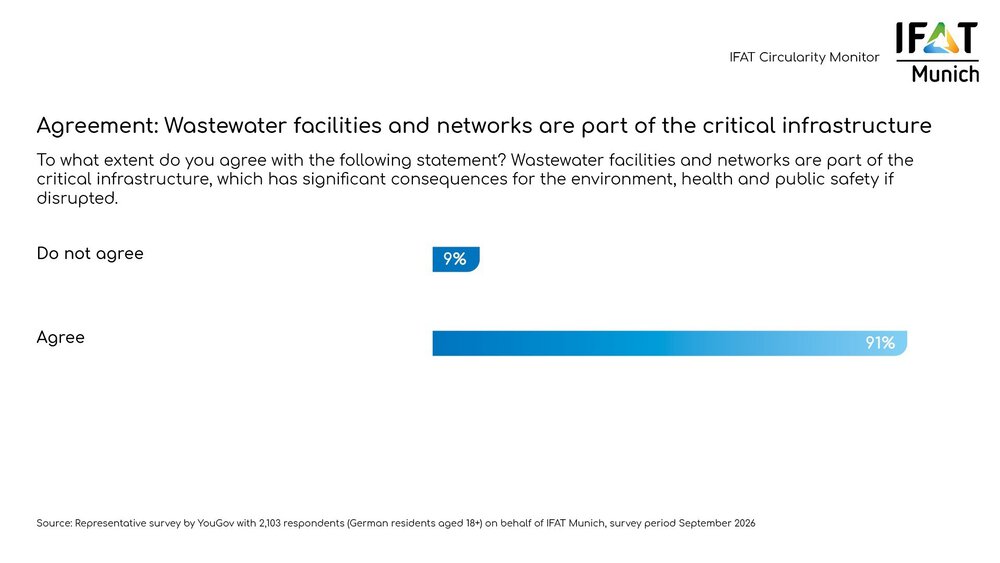
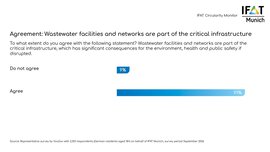
Respondents have a particularly high level of awareness when it comes to wastewater. 91 percent recognize disruptions in wastewater disposal as a serious threat to the environment, health and public safety. At the same time, this part of the infrastructure is largely invisible in everyday life – and is therefore rarely discussed strategically.
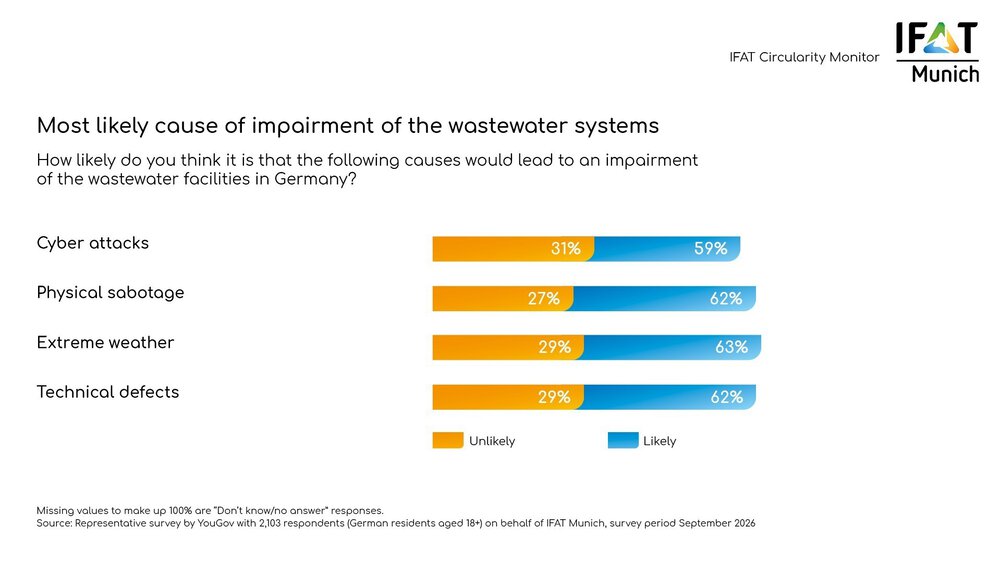
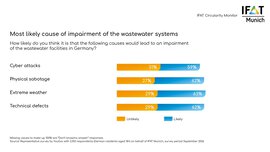
In terms of wastewater infrastructure, the IFAT Circularity Monitor identifies extreme weather as the greatest perceived risk (63 percent)**, followed by physical sabotage and technical defects (62 percent each)**. For the German Association for Water,
Wastewater and Waste (DWA), the results underline the pressure to act. “Wastewater facilities are systemically relevant, even if they often take a back seat in people’s minds,” says Managing Director Lisa Irwin-Broß. “The fact that the population recognizes these connections so clearly is an important signal. The water industry is highly committed to also ensuring supply security at all times in the future. During the power outage in Berlin at the turn of the year, the water industry impressively demonstrated its efficiency. The water utility company Berliner Wasserbetriebe was able to maintain the water supply and wastewater disposal thanks to the emergency power supply.”
* The data in this survey is based on online interviews with members of the YouGov panel who agreed to participate in advance. A total of 2,103 people were surveyed between January 12 and 14, 2026. The survey was quota-based by age, gender and region, and the results were then weighted accordingly. The results are representative of the resident population in Germany aged 18 and over.
** Very or rather likely
Downloads
Belonging images

Matthias Glötzner
- PR Manager
+49 89 949-21483
+49 89 949-21483Write an e-mail
Write an e-mail